 Add to Chrome
 Add to Firefox
 Add to Edge
Agentic AI for Remote Sensing: Technical Challenges and Research Directions
Apr 27, 2026
Earth Observation (EO) is moving beyond static prediction toward multi-step analytical workflows that require coordinated reasoning over data, tools, and geospatial state. While foundation models and vision-language models have expanded representation learning and language-grounded interaction for remote sensing, and agentic AI has demonstrated long-horizon reasoning and external tool use, EO is not a straightforward extension of generic agentic AI. EO workflows operate over georeferenced, multi-modal, and temporally structured data, where operations such as reprojection, resampling, compositing, and aggregation actively transform the underlying state and can constrain subsequent analysis. As a result, errors may propagate silently across steps, and correctness depends not only on internal coherence, but also on geospatial consistency, temporally valid comparisons, and physical validity. This position paper argues that these challenges are structural rather than incidental. We identify the implicit assumptions commonly made in generic agentic models, analyze how they break in geospatial workflows, and characterize the resulting failure modes in multi-step EO pipelines. We then outline design principles for EO-native agents centered on structured geospatial state, tool-aware reasoning, verifier-guided execution, and learning objectives aligned with geospatial and physical validity. Finally, we present research directions spanning EO-specific benchmarks, hybrid supervised and reinforcement learning, constrained self-improvement, and trajectory-level evaluation beyond final-answer accuracy. Building reliable geospatial agents therefore requires rethinking agent design around the physical, geospatial, and workflow constraints that govern EO analysis.

GCA Framework: A Gulf-Grounded Dataset and Agentic Pipeline for Climate Decision Support
Apr 14, 2026Climate decision-making in the Gulf increasingly demands systems that can translate heterogeneous scientific and policy evidence into actionable guidance, yet general-purpose large language models (LLMs) remain weak both in region-specific climate knowledge and grounded interaction with geospatial and forecasting tools. We present the GCA framework, which unifies (i) GCA-DS, a curated Gulf-focused multimodal dataset, and (ii) Gulf Climate Agent (GCA), a tool-augmented agent for climate analysis. GCA-DS comprises ~200k question-answer pairs spanning governmental policies and adaptation plans, NGO and international frameworks, academic literature, and event-driven reporting on heatwaves, dust storms, and floods, complemented with remote-sensing inputs that couple imagery with textual evidence. Building on this foundation, the GCA agent orchestrates a modular tool pipeline grounded in real-time and historical signals and geospatial processing that produces derived indices and interpretable visualizations. Finally, we benchmark open and proprietary LLMs on Gulf climate tasks and show that domain fine-tuning and tool integration substantially improve reliability over general-purpose baselines.
OpenEarthAgent: A Unified Framework for Tool-Augmented Geospatial Agents
Feb 19, 2026Recent progress in multimodal reasoning has enabled agents that can interpret imagery, connect it with language, and perform structured analytical tasks. Extending such capabilities to the remote sensing domain remains challenging, as models must reason over spatial scale, geographic structures, and multispectral indices while maintaining coherent multi-step logic. To bridge this gap, OpenEarthAgent introduces a unified framework for developing tool-augmented geospatial agents trained on satellite imagery, natural-language queries, and detailed reasoning traces. The training pipeline relies on supervised fine-tuning over structured reasoning trajectories, aligning the model with verified multistep tool interactions across diverse analytical contexts. The accompanying corpus comprises 14,538 training and 1,169 evaluation instances, with more than 100K reasoning steps in the training split and over 7K reasoning steps in the evaluation split. It spans urban, environmental, disaster, and infrastructure domains, and incorporates GIS-based operations alongside index analyses such as NDVI, NBR, and NDBI. Grounded in explicit reasoning traces, the learned agent demonstrates structured reasoning, stable spatial understanding, and interpretable behaviour through tool-driven geospatial interactions across diverse conditions. We report consistent improvements over a strong baseline and competitive performance relative to recent open and closed-source models.
Towards PerSense++: Advancing Training-Free Personalized Instance Segmentation in Dense Images
Aug 20, 2025Segmentation in dense visual scenes poses significant challenges due to occlusions, background clutter, and scale variations. To address this, we introduce PerSense, an end-to-end, training-free, and model-agnostic one-shot framework for Personalized instance Segmentation in dense images. PerSense employs a novel Instance Detection Module (IDM) that leverages density maps (DMs) to generate instance-level candidate point prompts, followed by a Point Prompt Selection Module (PPSM) that filters false positives via adaptive thresholding and spatial gating. A feedback mechanism further enhances segmentation by automatically selecting effective exemplars to improve DM quality. We additionally present PerSense++, an enhanced variant that incorporates three additional components to improve robustness in cluttered scenes: (i) a diversity-aware exemplar selection strategy that leverages feature and scale diversity for better DM generation; (ii) a hybrid IDM combining contour and peak-based prompt generation for improved instance separation within complex density patterns; and (iii) an Irrelevant Mask Rejection Module (IMRM) that discards spatially inconsistent masks using outlier analysis. Finally, to support this underexplored task, we introduce PerSense-D, a dedicated benchmark for personalized segmentation in dense images. Extensive experiments across multiple benchmarks demonstrate that PerSense++ outperforms existing methods in dense settings.
ThinkGeo: Evaluating Tool-Augmented Agents for Remote Sensing Tasks
May 29, 2025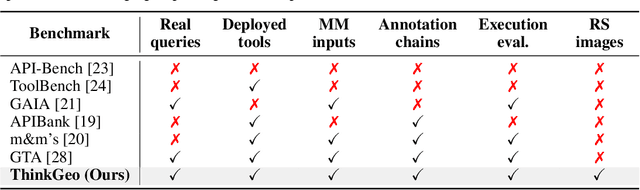
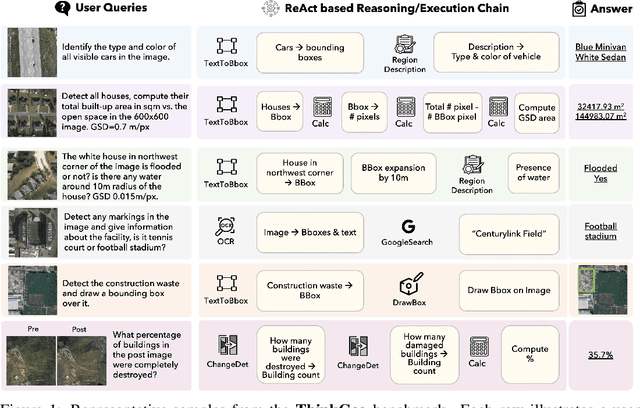
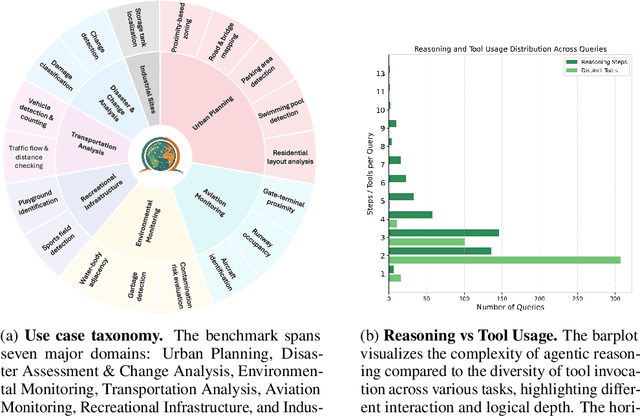
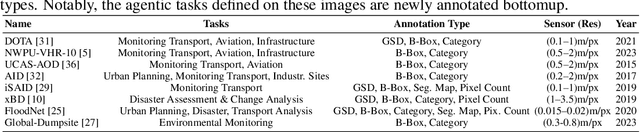
Recent progress in large language models (LLMs) has enabled tool-augmented agents capable of solving complex real-world tasks through step-by-step reasoning. However, existing evaluations often focus on general-purpose or multimodal scenarios, leaving a gap in domain-specific benchmarks that assess tool-use capabilities in complex remote sensing use cases. We present ThinkGeo, an agentic benchmark designed to evaluate LLM-driven agents on remote sensing tasks via structured tool use and multi-step planning. Inspired by tool-interaction paradigms, ThinkGeo includes human-curated queries spanning a wide range of real-world applications such as urban planning, disaster assessment and change analysis, environmental monitoring, transportation analysis, aviation monitoring, recreational infrastructure, and industrial site analysis. Each query is grounded in satellite or aerial imagery and requires agents to reason through a diverse toolset. We implement a ReAct-style interaction loop and evaluate both open and closed-source LLMs (e.g., GPT-4o, Qwen2.5) on 436 structured agentic tasks. The benchmark reports both step-wise execution metrics and final answer correctness. Our analysis reveals notable disparities in tool accuracy and planning consistency across models. ThinkGeo provides the first extensive testbed for evaluating how tool-enabled LLMs handle spatial reasoning in remote sensing. Our code and dataset are publicly available
PerSense: Personalized Instance Segmentation in Dense Images
May 22, 2024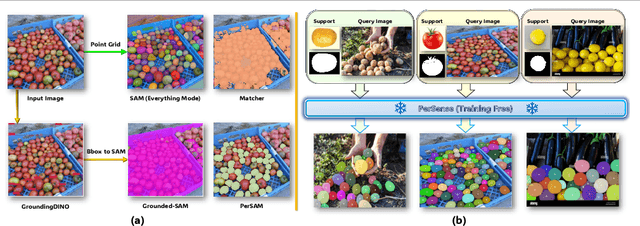
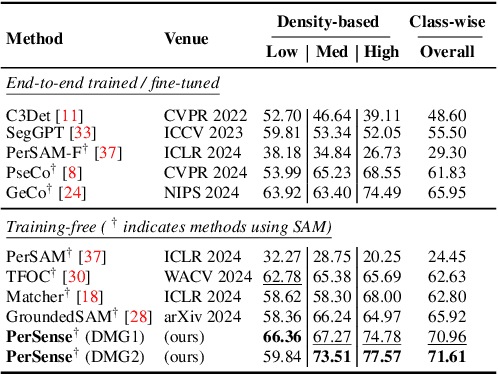
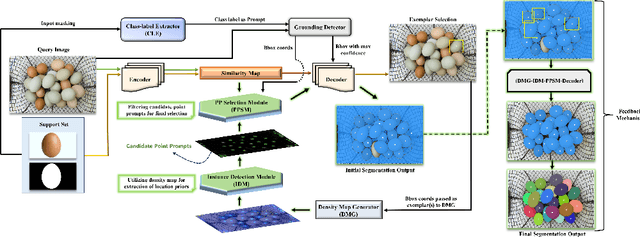
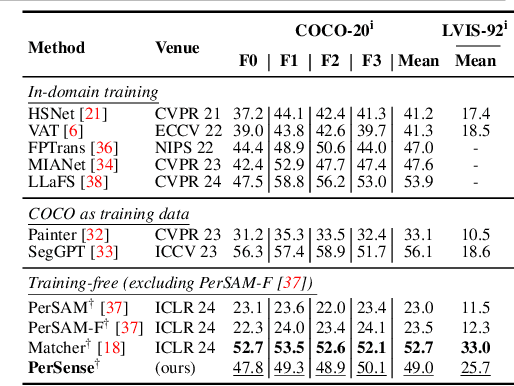
Leveraging large-scale pre-training, vision foundational models showcase notable performance benefits. While recent years have witnessed significant advancements in segmentation algorithms, existing models still face challenges to automatically segment personalized instances in dense and crowded scenarios. The primary factor behind this limitation stems from bounding box-based detections, which are constrained by occlusions, background clutter, and object orientation, particularly when dealing with dense images. To this end, we propose PerSense, an end-to-end, training-free, and model-agnostic one-shot framework to address the personalized instance segmentation in dense images. Towards developing this framework, we make following core contributions. (a) We propose an Instance Detection Module (IDM) and leverage a Vision-Language Model, a grounding object detector, and a few-shot object counter (FSOC) to realize a new baseline. (b) To tackle false positives within candidate point prompts, we design Point Prompt Selection Module (PPSM). Both IDM and PPSM transform density maps from FSOC into personalized instance-level point prompts for segmentation and offer a seamless integration in our model-agnostic framework. (c) We introduce a feedback mechanism which enables PerSense to harness the full potential of FSOC by automating the exemplar selection process. (d) To promote algorithmic advances and effective tools for this relatively underexplored task, we introduce PerSense-D, a dataset exclusive to personalized instance segmentation in dense images. We validate the effectiveness of PerSense on the task of personalized instance segmentation in dense images on PerSense-D and comparison with SOTA. Additionally, our qualitative findings demonstrate the adaptability of our framework to images captured in-the-wild.